






“It worked in staging.”
Every engineering team has heard it. Sometimes the sentence is followed by a shrug. Sometimes by a production incident.
A release can pass thousands of automated checks and look perfectly healthy in staging. Then a third-party API slows down, a webhook arrives late, or an external service returns a state the application has never encountered. A workflow that behaved perfectly during development suddenly behaves differently in production.
The usual response is to add another test.
That makes sense when the missing scenario is a piece of application logic. But when the problem lies in the environment, adding more tests against the same conditions only gives the team more confidence in those conditions.
Test coverage measures how much code you’ve exercised. It doesn’t measure how many assumptions you’ve challenged.
When the Environment Becomes the Unknown
Modern applications depend on a growing number of systems that engineering teams don’t control. A single workflow can involve internal services, identity providers, payment APIs, notification platforms, cloud services, and third-party integrations.
Each dependency brings its own behavior.
An API can become slower during peak traffic. A provider can temporarily reject requests. A webhook can arrive out of sequence. A service can change state between two calls. An older API version may still be required by one customer.
These situations are difficult to account for when development environments are built around predictable responses.
And that is where the gap between development and production starts to appear.
Mocks and Sandboxes Have a Job. They Just Can’t Do Everything.
Mocks, vendor sandboxes, and shared environments remain useful engineering tools. They help developers build integrations without connecting directly to live infrastructure and make collaboration easier.
Their limitations become apparent when teams need to reproduce less predictable behavior.
A mock generally returns what it was configured to return. A vendor sandbox may expose only part of a provider’s capabilities or become difficult to access when multiple teams need it. Shared environments introduce another challenge: one team’s changes can affect another’s work, making specific scenarios harder to reproduce consistently.
Consider a webhook-driven workflow.
The normal sequence is straightforward:
Request → Response → Callback → Completed workflow
The difficult cases begin when the callback is delayed, a request is retried, the underlying resource changes state, or the dependency becomes temporarily unavailable.
Those are precisely the situations that tend to surface after deployment.
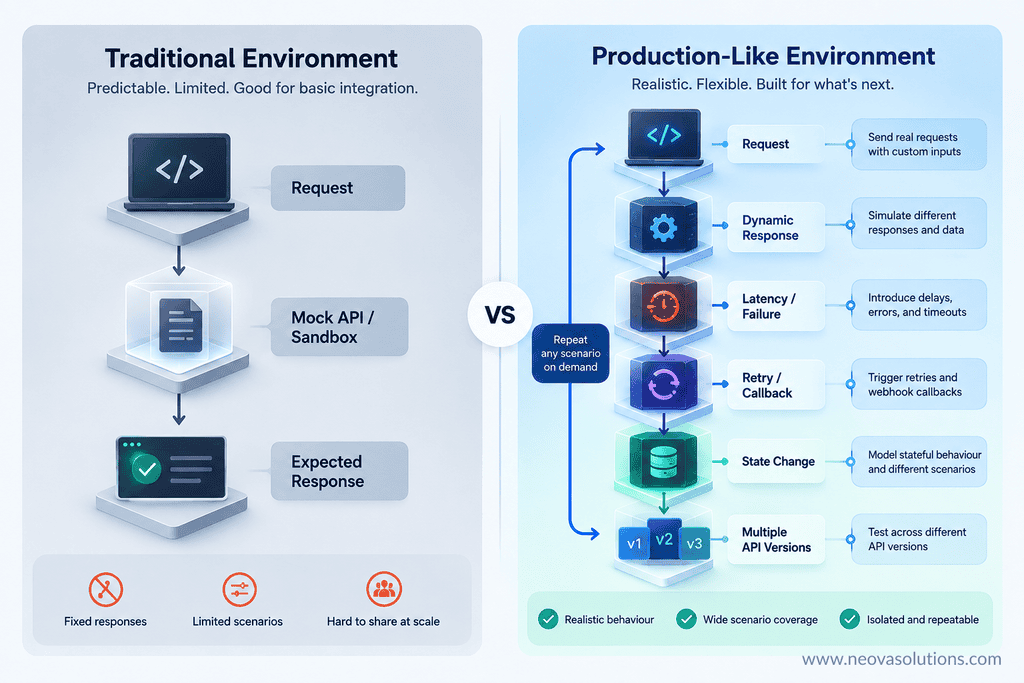
The Power of Production-Like Test Environments
This is where the idea of “more tests = better quality” starts to break down.
A team can have hundreds of checks around an integration and still miss a single environmental condition that changes how the system behaves.
A more useful environment gives engineers control over those conditions. They should be able to introduce latency, failures, retries, dynamic responses, asynchronous callbacks, state changes, and different API versions without waiting for an external system to produce them.
That is what makes an environment production-like. It doesn’t need to reproduce every component of production. It needs to reproduce the behaviors that can materially affect the application.
Making Difficult Scenarios Repeatable
Simulation makes those behaviors available on demand.
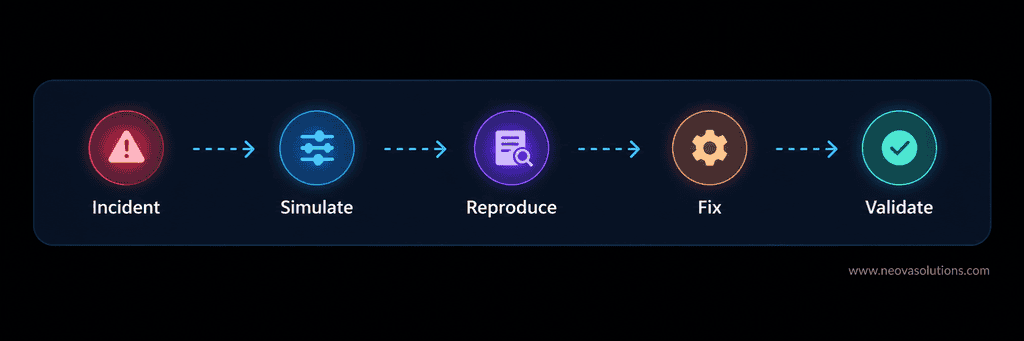
An engineer investigating a failed workflow can recreate the same delayed callback. A team working on retry logic can repeatedly make a dependency fail. An integration can be exercised against different API versions without waiting for a vendor to provide access.
That repeatability turns an occasional production surprise into a scenario engineers can investigate, fix, and revisit.
It also makes simulation useful beyond release validation. Developers can build against realistic dependencies, teams can reproduce integration issues earlier, and organizations can work in isolated environments without constantly competing for shared infrastructure.
Giving Engineers More Control
This is where neoSimAI fits into the workflow.
neoSimAI provides isolated environments where teams can simulate the systems their applications depend on. They can reproduce requests and responses, model stateful behavior, introduce latency and failures, trigger webhook callbacks, and work with multiple API versions without relying entirely on third-party sandboxes.
The practical difference is that engineers can create the condition they need instead of waiting for an external dependency to create it.
That gives development, integration, and QA teams a repeatable environment for building and validating complex workflows while keeping production infrastructure out of the loop.
Conclusion
Modern software has too many moving parts for development environments to remain perfectly predictable.
Automation and test coverage still matter. But reliable software delivery also depends on giving engineers realistic conditions in which to understand how their systems behave.
Production will always contain surprises. Good engineering environments give teams a chance to encounter some of them before their customers do.


